
Planner
plannersplits the work into a graph of slices with dependencies
graph · slice · deps
Zelari-Code · Open source
An open-source coding orchestrator: you choose the model, the proof is mandatory. Kraken splits the work and delegates it to specialised tentacles, and a turn cannot close as successful until verification passes.
$ zelari-code
[ok] Kraken online · 4 tentacles ready
[ok] strict-done ON · worktree ON
[kraken] lead · splits the work into slices
01The problem
A single chat thread is not a development workflow, and without verification you do not know whether the work is really done.
In long sessions context fades: the model forgets decisions made two hours earlier.
The agent says it works and nobody runs the tests or the build before closing.
Several steps edit the same files in the same tree, with no isolation and no rollback.
Either you approve every command by hand or you let everything through: there is no policy in between.
Hard to trace what happened, why a command was denied or who wrote what.
Kraken splits and delegates, every writer works in an isolated worktree, a blind reviewer judges from real output and the strict-done gate refuses to close with open verification. Everything lands on the session spine, replayable at any time.
02Features
Not an autocomplete, not a chat agent: an orchestrator that proves the work instead of claiming it.
A coordinating lead and four roles: Planner, Explorer, Builder and Checker. Each role can use a different model, even from another provider. The six-role council is still there when the work earns a second opinion.
Every writing tentacle works in a private git worktree seeded from your tree, uncommitted changes included. When it is done it squash-merges back; on a conflict it rolls back without touching your work.
The Checker is blind: it only sees the real output of tests, typecheck and build. A written PASS with no executed commands does not count; with open verification the turn does not close as successful (exit 4).
Allow/ask/deny rules evaluated before every tool, strict, standard and yolo presets, and a deterministic command classifier (safe, review, destructive, blocked). Every denial is recorded.
A replayable session spine, the .zelari/ workspace, deterministic compaction and resumable sessions. Outcome memory only records work that passed verification.
Grok, ChatGPT, Claude, Muse, GLM, MiniMax, DeepSeek, Xiaomi MiMo or any OpenAI-compatible endpoint. A prompt-cache-friendly layout: since 2.65, about 12,500 fewer tokens per lead request.
03How it works
The default flow in kraken mode: from request to merge, with verification as the condition for closing.
Kraken reads the request, splits it into slices and decides what to do itself and what to delegate.
Read-only tentacles map the relevant code and report what they found.
Builders write in isolated git worktrees, starting from your current working tree.
A blind Checker runs tests, typecheck and build: the verdict comes only from real output.
Squash-merge into your tree. With open verification debt the turn does not close as successful.
04Architecture
A coordinating lead and four specialised roles, each with its own model and thinking effort.
splits the work into a graph of slices with dependencies
graph · slice · deps
reads and maps the code, never writes
read-only · quick/medium/deep
writes in a private worktree, then squash-merges
.zelari/worktrees/ · merge
judges only from real command output
npm test · tsc → VERDICT
On demand
When the work earns a second opinion: six roles in sequence for planning, ideas, knowledge mapping, critique and synthesis. From the CLI with --mode council; in Desktop 2.65 the modes are Kraken and Zelari.
Orchestrator · Director
frames the problem and delegates
mandate → specialists
Planner
buildable plan, phases and tasks
createPlan · phases × tasks
Ideator
creative divergence, then top pick
journey · IA · tokens
Knowledge Architect
navigable concept map
knowledge-map
Quality Critic
exposes gaps and risks, no product code
risks · scores
Synthesizer · Implementer
synthesis; implements only when enabled
synthesis · write/edit
05Session
Illustrative flow in kraken mode, headless with the strict-done gate. Simplified output; the tentacles, worktree and gate are the real ones.
$ zelari-code --headless --task "Add pagination to GET /tasks" --strict-done
[kraken] lead · plan in 3 slices ✓
[explore] /tasks route + existing tests · read-only ✓
[general] worktree .zelari/worktrees/t2 · 4 files ✓
[verify] npm test · tsc --noEmit → PASS ✓
[merge] squash-merge into the lead tree ✓
[gate] strict-done · evidence on the spine ✓
> exit 0 · verified, not claimed
06Interfaces
zelari-code: scriptable, with /update, --doctor --fix and slash commands.
Keyboard-first interactive console, configurable status line, Ctrl+O for full tool output.
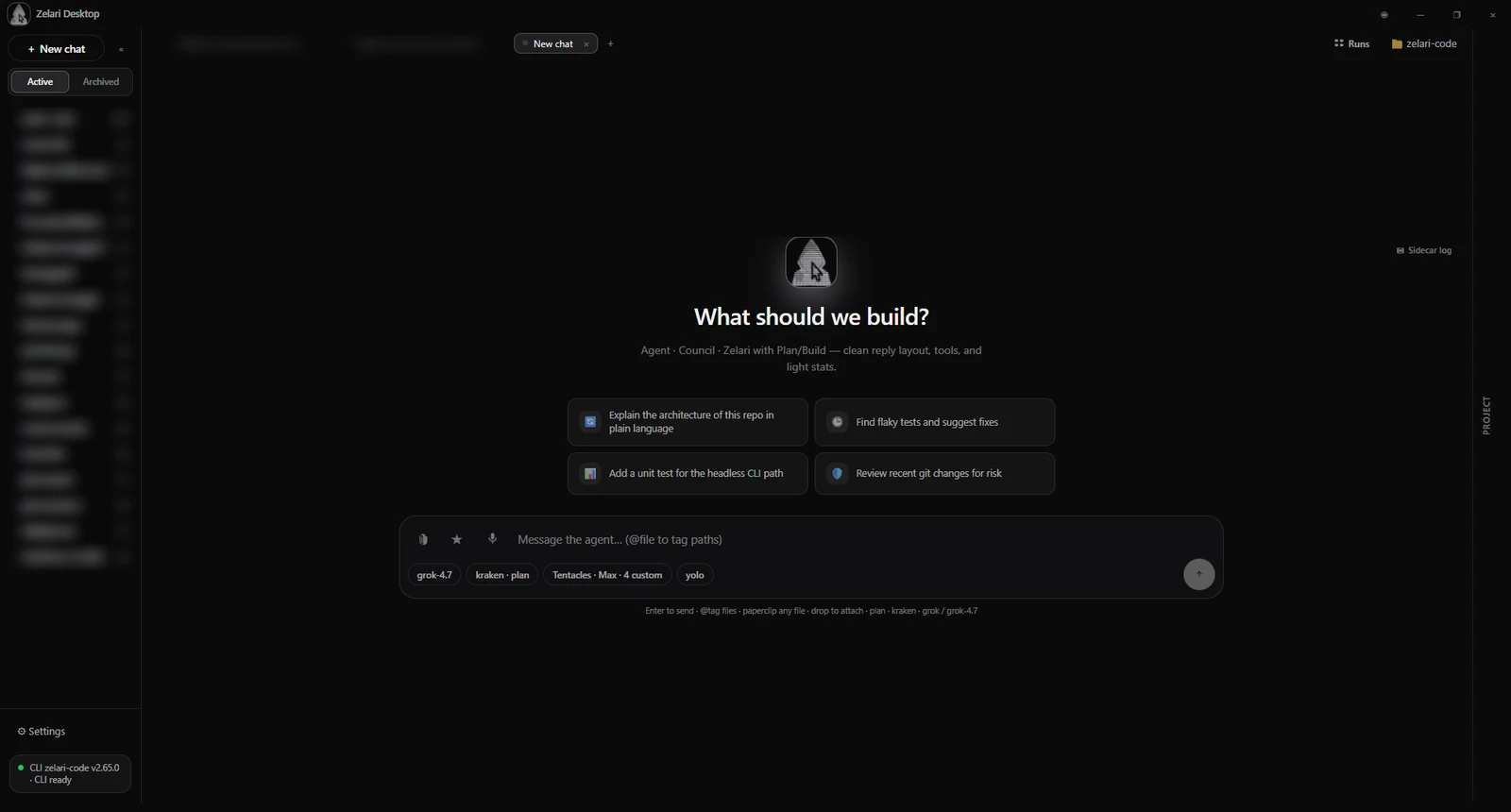
Tauri workbench with tabs, Kraken activity, MCP and SSH. Runs the CLI as a sidecar.
--headless --task with JSON output, exit codes 0–4 and trajectory export in ATIF format.
zelari-code acp speaks the Agent Client Protocol: Zed, Neovim and an experimental VS Code extension.
Your phone as a thin client over Tailscale or LAN: approvals, questions and run steering.
07Desktop · v2.65.0
A workbench, not a chat window: per-project tabs, live tentacle activity, models and permissions one click away. Same engine as the CLI.

Conversations open as tabs and the sidebar groups them by project. Parallel chats on different projects stay isolated.
Pick the delegation level (Automatic, Prefer, Maximum, Lead only) and a model and thinking effort per role, right from the composer.
Every tentacle with its status, duration, model and actual provider. One whose tool calls mostly failed is flagged as "degraded".
Every run from every conversation in one drawer, with project, starting prompt and live status.
Catalog or custom MCP servers, SSH connections with a command allowlist, and readable system notices that say what happened and what to do.
Pair your phone with a QR code: approve or deny tools, answer the agent's questions and steer the run while you are away from your desk.
08Download
Optional Tauri shell for long sessions, tentacle activity and parallel chats. Same engine as the CLI.
Installer v2.65.0. The installer does not install or update the CLI: use npm i -g zelari-code (or Settings → Update CLI). On first launch a setup guide checks Node and the CLI.
Requirements and setup
v2.65.0 · Desktop shell · Apache-2.0
09Use cases
Where Zelari-Code makes a difference compared with plain chat coding.
From brief to merge: Kraken plans, Builders implement in parallel and the Checker verifies before closing.
Multi-file refactors with no risk to your tree: isolated worktrees and rollback when a merge fails.
The council weighs plan, alternatives and risks before any code is written.
Headless with --permissions yolo and strict-done: the exit code tells you whether the work is really verified.
Replayable sessions with reports: intent, decisions, denials and outcomes in a single thread.
10Comparison
What changes compared with a generic chat assistant.
| Capability | Chat coding | Zelari-Code |
|---|---|---|
| Architecture | Chat codingsingle-agent chat | Zelari-CodeKraken + tentacles, council on demand |
| Definition of done | Chat codingon trust | Zelari-Codeblind Checker + strict-done |
| Write isolation | Chat codingsame tree | Zelari-Codegit worktree per tentacle |
| Permissions | Chat codingall or nothing | Zelari-Codeallow/ask/deny policy |
| Project memory | Chat codingephemeral | Zelari-Codepersistent (.zelari/) |
| Audit | Chat codingscattered logs | Zelari-Codesession spine + replay |
| Models | Chat codingoften lock-in | Zelari-Codeone per role, any provider |
| Interfaces | Chat codingvaries | Zelari-CodeCLI · TUI · Desktop · ACP · mobile |
11Security
Kraken works for you, not instead of you without supervision.
No turn closes as successful with open verification: the strict-done gate is on by default in kraken build mode.
Allow/ask/deny rules before every tool, with deny always winning. Every denial lands on the spine with the rule that caused it.
A git worktree for every writer, a snapshot of your uncommitted work and automatic rollback when a merge fails.
A deterministic classifier, no LLM involved, tags every command as safe, review, destructive or blocked.
Resume, replay and end-of-session reports rebuilt from the spine: you can always trace the why.
Source on GitHub, packages on npm (zelari-code and @zelari/core). Built by Anathema Studio.
12FAQ
Quick answers before the full documentation.
Commercial support or custom integrations?
Contact13Documentation
Kraken and tentacles, mode and phase, permissions, interfaces and install. The CLI reference lives in the repo (docs/GUIDE.md).
Next step
Open source Apache-2.0: run npx zelari-code@latest, install from npm or download Desktop 2.65.0. Contact us for commercial support and custom integrations.
npx zelari-code@latest · Apache-2.0

Always online